
Digital enterprise, household bargaining power, and the limits of technology-led inclusion
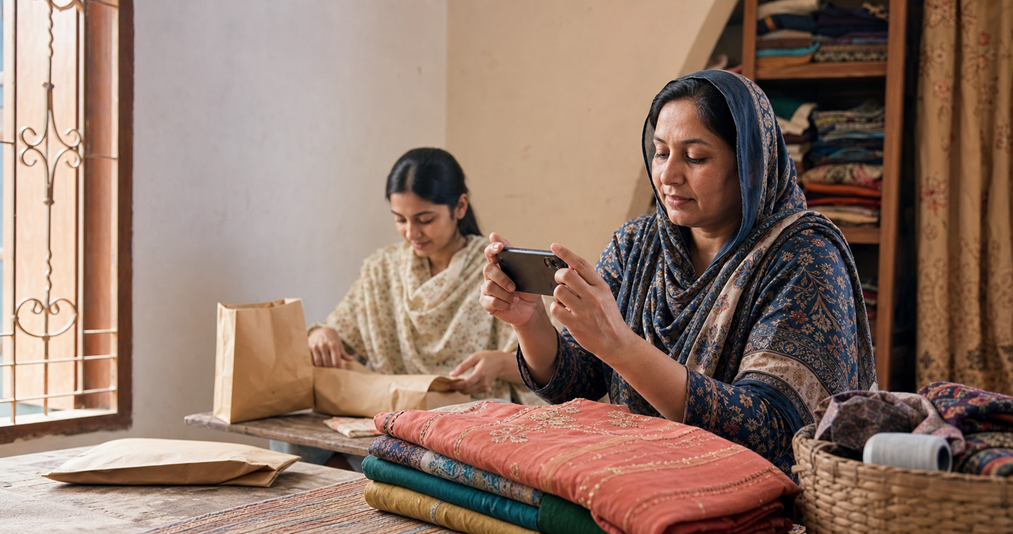
CENTRAL FINDING Digital entrepreneurship can expand income, household voice, and confidence—but only when women control the device, the account, the earnings, and enough time to sustain the enterprise.
A Case Study
In Punjab’s crowded cities, peri-urban settlements, and rural villages, a quiet economic shift is taking place. For many women from low-income households, the tools of enterprise are no longer limited to a market stall, a shop, or a male relative who sells on their behalf. A low-cost smartphone, a WhatsApp account, or a Facebook page can now connect a home-based producer directly with customers. Women sell stitched clothing, embroidered shawls, homemade pickles, beauty products, and handicrafts; a smaller, more educated group provides online services such as graphic design, content writing, and virtual assistance.
This change matters because poor women in Punjab have historically faced severe restrictions on paid work. Limited mobility, unpaid care responsibilities, safety concerns, low asset ownership, and weak access to banking have confined many to informal activities with little control over prices or profits. Digital entrepreneurship does not remove these barriers, but it can alter how women work around them. Its importance lies not simply in putting existing businesses online, but in changing who controls the customer relationship, the payment, and the decision to spend or save.
A New Door into Economic Life
Traditional income opportunities for poor women in Punjab have often included agricultural labor, domestic service, piece-rate stitching, and home-based production. These activities may generate income, but women commonly remain separated from the final buyer. A middleman, shopkeeper, or male relative sets the price, arranges transport, and captures part of the profit. Cultural restrictions on women’s movement make it difficult to search for customers, visit banks, or negotiate in public markets.
Digital platforms reduce some of these costs. A woman can photograph a product at home, advertise it through WhatsApp or Facebook, receive an order, and collect payment through cash on delivery or a mobile wallet. WhatsApp is especially accessible because it is familiar, inexpensive, and suited to trust-based selling through personal networks. Facebook and Instagram provide wider visibility, while TikTok and YouTube Shorts allow sellers to combine demonstrations, storytelling, and promotion. Freelancing platforms offer access to national and international clients, although they demand stronger education, language skills, reliable internet, and knowledge of digital payments.
These models are not equally accessible. Social-media selling has a low entry barrier but often produces modest profits, while higher-return freelancing requires stronger education and connectivity. Digital entrepreneurship can therefore reproduce inequalities among women: those with their own phones, stronger literacy, and supportive families are more likely to enter profitable online work.
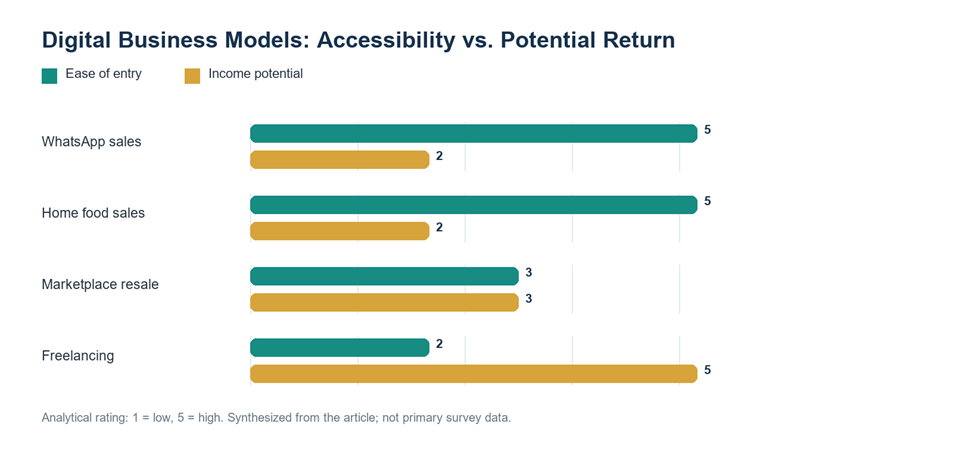
Figure 1. Analytical comparison of business models. Ratings synthesize the article’s reasoning; they are not survey measurements.
Three Pathways to Empowerment
Research on low-income women participating in digital-enterprise initiatives in Punjab points to three connected outcomes: financial autonomy, household decision-making power, and psychological confidence.
The first is financial autonomy. Even a small independent income can change a woman’s position when she previously had to request money for school supplies, medicine, or personal needs. Direct payments allow her to decide whether to spend, save, or reinvest. Mobile wallets can be particularly important for women without bank accounts because they create a personal channel for receiving and storing money. The source and control of income are as significant as its amount: money paid directly to a woman can strengthen autonomy more than income handled by another household member.
| ANALYSIS The pathways are mutually reinforcing: income can increase household credibility, household voice can unlock time and reinvestment, and confidence can strengthen negotiation. Failure in one pathway can weaken the others. |
The second pathway is greater influence over household decisions. When a woman contributes regularly to food, education, healthcare, or utility costs, relatives may begin to view her as a co-provider rather than solely as a dependent. This can increase her voice in decisions concerning purchases, schooling, savings, or borrowing. However, income does not automatically produce bargaining power. In supportive households, earnings may reinforce respect and cooperation. In resistant households, husbands or in-laws may restrict phone use, monitor customers, control revenue, or prevent the business from expanding. Family support is therefore not a minor background condition; it is a gatekeeper that shapes whether economic activity becomes genuine empowerment.
The third pathway is psychological confidence. Running a business requires a woman to present her work, state a price, communicate with strangers, resolve complaints, and make decisions. These experiences can create an identity beyond her domestic roles. Greater confidence may encourage further training, product expansion, and reinvestment. It can also spill into other areas, such as helping children use online resources or assisting other women with digital tools.
These outcomes reinforce one another. Income can strengthen a woman’s credibility in family discussions; decision-making power can increase her control over time and business resources; and confidence can improve negotiation with customers and relatives. The reverse is also true. Irregular sales, household resistance, online harassment, or failed deliveries may weaken all three outcomes. Empowerment is therefore a dynamic process, not a one-time result of owning a smartphone.
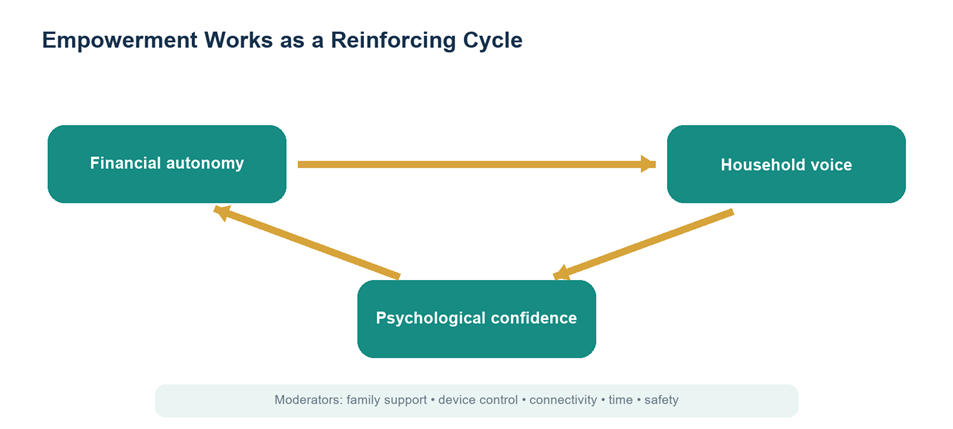
Figure 2. The three empowerment pathways form a feedback loop moderated by household and infrastructure conditions.
What the Typical Cases Reveal
Consider a home-based tailor who begins posting photographs of her work and reaches buyers beyond her neighborhood. Payments to her own mobile wallet may provide both a wider market and direct control over earnings. Yet growth still depends on materials, delivery, and uninterrupted phone access.
A food entrepreneur may enter with little capital by using skills and equipment already available at home. WhatsApp can expand her market, but if a male relative must deliver every order, the business reduces one dependency while creating another.
A younger trainee may earn more through freelancing and use that income for education. However, success depends on schooling, language proficiency, equipment, payment access, and platform competition.
These examples show that technology does not empower women in isolation. Outcomes depend on who owns the device, who controls the account, who performs delivery, and whether the woman controls the proceeds. A business can appear digitally successful while leaving household power relations largely unchanged.
Persistent and Interlocking Barriers
The digital gender gap remains the most basic limitation. Many poor women do not own smartphones, cannot afford data, or share a device whose use is prioritized for men’s work or children’s education. Rural connectivity, electricity interruptions, weak delivery systems, and limited access to formal credit further restrict growth. Women also face fraudulent buyers, unwanted messages, and reputational risks that can lead families to oppose their online presence.
Time poverty is equally important. Digital work is usually added to cooking, cleaning, childcare, and eldercare rather than replacing them. A woman may become an earner without any redistribution of domestic labor. This creates “empowerment without relief”: income rises, but so does exhaustion. Evaluating success only through sales can therefore hide important costs to health, time, and well-being.
| STRUCTURAL ANALYSIS Barriers accumulate. Shared devices, weak connectivity, delivery dependence, unpaid care, and lack of credit combine to create a low-productivity trap even when demand exists. |
The barriers are cumulative. Shared phone access reduces the time available to answer customers; weak connectivity makes that limited time less productive; dependence on relatives delays delivery; and limited savings prevent investment in better equipment. Together, these constraints can trap women in low-volume, low-profit activity even when demand exists.
Evidence and Its Limits
Research generally reports a positive relationship between digital-enterprise participation and women’s autonomy, decision-making, and confidence. Different forms of evidence support the overall case, but caution is necessary.
Participants may already be more educated, motivated, connected, or supported than women who cannot join. Self-reported autonomy may not correspond to verified income or lasting changes in household power, and statistical association does not prove causation. Stronger evidence would compare similar participants and non-participants, verify earnings, and track whether gains survive after program support ends. Digital entrepreneurship is therefore a promising lever, not a guaranteed solution.
| EVIDENCE CAUTION Reported associations are meaningful, but participant selection and self-reported outcomes limit causal claims. Longitudinal comparison groups and verified net earnings would strengthen the evidence base. |
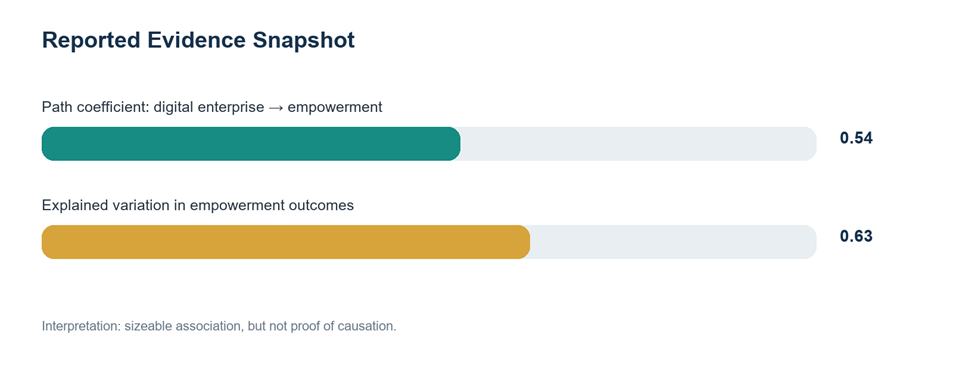
Figure 3. Statistics reported in the supplied source article. Values should be checked against the original study before academic publication.
Policy Priorities
Effective programs should combine four layers of support: affordable access and digital safety; practical business and financial training; connections to logistics, credit, and larger markets; and durable support through household engagement, childcare, protection from harassment, and formalization opportunities.
Programs should measure more than enrollment and training completion. Relevant indicators include net income after costs, control over earnings, repeat customers, business survival, changes in unpaid workload, and participation in household decisions. Equity must also guide recruitment. Programs that select only women who already own smartphones and have supportive families may achieve impressive averages while excluding those with the greatest need.
Conclusion
Digital entrepreneurship is reshaping economic opportunity for some poor household women in Punjab by allowing them to reach customers, receive payments, and build economic identities from within the home. Its effects can extend beyond income to stronger household influence and greater self-confidence. However, the transformation remains partial. Technology works through existing social structures and may reproduce inequalities when access, education, mobility, and family support are uneven.
The central lesson is that a smartphone is not itself empowerment. It becomes empowering when a woman can use it safely, control the income it generates, obtain the time and support required to sustain her work, and move from subsistence selling toward a stable enterprise. Digital entrepreneurship is best understood as a real but conditional lever—one whose power depends on the social, financial, and institutional system surrounding it.
Figure Notes
- The cover image is AI-generated and illustrative; no claim is made that it represents a real program participant.
- Figure 1 is a qualitative analytical framework based on the article’s comparison of entry barriers and earning potential.
- Figure 3 visualizes β = 0.54 and R² = 0.63 as reported in the user-supplied source text. These figures require verification against the original publication before citation in academic work.
